Exterior mosquito and midge reduction balances active insect knockdown with careful environmental containment across sensitive Collier County waterfront zones. In neighborhoods like Port Royal, Aqualane Shores, and…
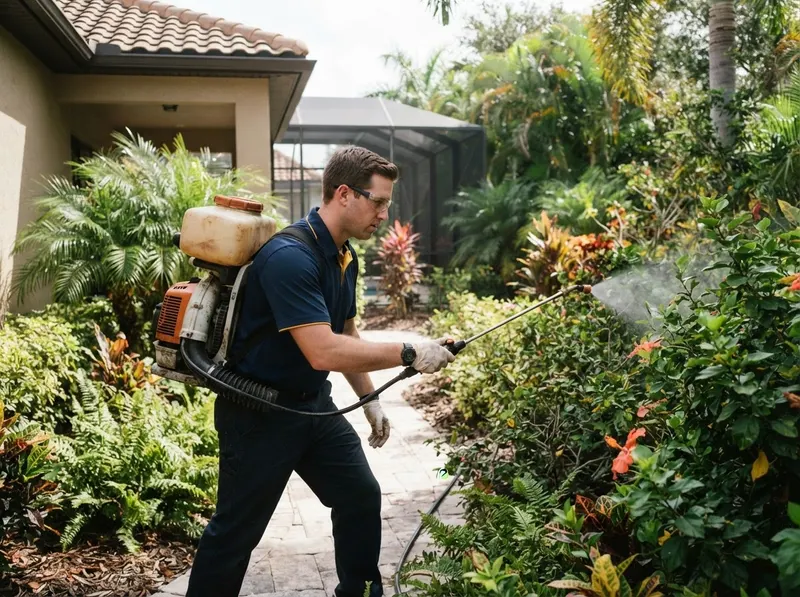
Exterior mosquito and midge reduction balances active insect knockdown with careful environmental containment across sensitive Collier County waterfront zones. In neighborhoods like Port Royal, Aqualane Shores, and along Moorings Bay, properties directly border tidal waters and canals where marine protection guidelines strictly govern chemical drift. Specialized ultra-low volume (ULV) equipment directs targeted botanicals and micro-encapsulated polymers strictly onto foliage undersides, such as sea grape, silver buttonwood, and dense ficus hedges, where adult insects rest during peak daytime heat. Applications purposefully bypass travertine pool decks, shellstone paths, and open water surfaces to preserve both delicate architectural stone and aquatic ecosystems. Biological larvicide briquettes containing Bacillus thuringiensis israelensis (BTI) are set into subterranean stormwater catch basins, landscape drains, and low-lying swales to stop emerging larvae before wings develop, preventing reproductive cycles in standing freshwater pockets.
Decision criteria depend heavily on lot geography and adjacent water types. For inland properties in Golden Gate Estates or golf communities such as Tiburon and Lely Resort, dense vegetative perimeters and retention lakes generate intense seasonal midge swarms that cling to screened enclosures and light fixtures. If the challenge is isolated to occasional perimeter swarms around an enclosed courtyard, localized manual larvicide placement paired with timed lighting changes provides adequate relief; if adult populations drift continuously from mangrove shorelines or golf lakes, comprehensive barrier misting every 21 to 30 days is required to establish an effective residual perimeter. The trade-off involves application frequency versus coverage permanence: non-persistent, drift-managed barrier treatments safeguard natural waterways and non-target beneficial pollinators near Naples Botanical Garden and Baker Park, but require disciplined monthly re-application throughout the humid May-to-October rainy stretch.
Treatment execution follows a documented three-step process: First, an on-site technician maps all drainage lines, lanai perimeters, and ornamentals across the grounds, identifying specific midge harboring zones while isolating sensitive edible gardens or koi features. Second, ground crews apply micro-encapsulated barrier materials to exterior foliage up to ten feet high, accompanied by targeted larvicide distribution across all enclosed drains and gutter lines. Third, the treatment concludes with a full visual survey of the structure, leaving clear re-entry instructions and a verified 30-day monitoring timeline tailored to seasonal rainfall shifts.
Every job gets a firm, written price after a free on-site visit.
Tell us about your exterior mosquito and midge reduction job in Naples and we'll send a clear, written quote, usually the same day.
 Honeycomb Pest Control